Chủ Nhật, 7 tháng 2, 2010

Eating Iquique: Seafood and Ají

I was wrong. There is picante Chilean food. (see "Do they eat chili in Chile?"). But you have to go a long way north to find it.


The dish above, Pescado a la Huara-Huara, is a filet of fish sautéed in olive oil with chilies, whole garlic cloves, spring onions and potatoes from the Restaurant El Viejo Wagon, in Iquique.  The sauce was delicious, rich with olive oil, garlic, wine and chilies, but not excessively hot, if one wisely left the chilies and garlic uneaten. But of course I ate the chilies; not all of them, but the sweet red ones (páprikas,) and some of the greenish yellow ones (ají verde), and one of the round rocotos; but only a little of the golden Peruvian ajís amarillos.  Unfortunately, that pretty well flamed my taste buds for the fish, a panyagua, said to be one of the most flavorful of the region; but it was worth it.  I hadn’t overdosed on chilies for years; it still feels good.


panyagua Hemilutjanus macropthalmos,
Grape-eye seabass 

It wasn’t simply coincidence that I ate this dish in Iquique.  Although thoroughly Chilean, 125 years after being “liberated” (along with the nitrate mines) from Peru, there is still a Peruvian tang to its cuisine.   A port city of 225,000 plus, Iquique is Chile’s most cosmopolitan city, with a foreign-born population of almost 10%:  ¾  Peruvians and Bolivians attracted by the availability of employment, but also Chinese and South Asians associated with the “Zofri,” Iquique’s duty free zone and a scattering of Americans from  the mining industry.[1]  And there is also a strong dash of the international from Chileans of English, American, Spanish, Greek, Croatian, Chinese origin whose ancestors immigrated in the 19th and early 20th centuries. 

But regardless ethnic origin, the real highlight of Iquique’s cuisine is the seafood.  Our first meal, and one of the best, was at the ornate Restauran Casino Española, built in 1904 in Moorish style as a club for Spanish owners and managers of the nitrate mines.   My choice was easy; the menu included mulata. one of many Chilean fishes that seldom appear on menus in Santiago. I had never tried it; its average size of 3 or 4 kg. in the fish market is too big for us and I had never seen it in fillets.  But from talking to the fish men, I knew it to be a firm fish, good grilled or sauteed.  On the menu it was Basque style, with a sauce of sautéed onions, cream, white wine, and saffron—and topped with freshly fried potato rounds, only slightly thicker than chips.  A good choice, a fine dish, and a restaurant not to be missed in Iquique.


Mulata, Graus nigra


Our next seafood meal was at Puerto Camaron, a small restaurant on the pedestrian mall in the historic city center:  An abundant shrimp salad and a shrimp pasta Alfredo.  Good, though probably with frozen shrimp from Ecuador.  We saw no fresh shrimp at the fish markets


The most common fish in Iquique this summer is palometa (Coryphaena hippurus, dolphin fish or mahi mahi), the whole fish and filets to the right below.  (The large center sections of fish to the left are albacorilla or toyo, Mustelus mento, a popular shark, known for its mild bone-free steaks.)


Everyone seemed to have an abundant supply of palometa, including Doña Margarita, filleting one below, who said they were locally available only in summer.  They were selling for 1,500 pesos a kg. ($3/lb) for whole fish; a low price for fresh fish in Chile (frozen filets are available in the US at $15.50 a lb.—plus shipping, fresh runs $25 a lb.)


Fried palometa at El Wagon


A highly recommended Iquique fish we did not try is cabrilla (Paralabrax humeralis), an inshore rock fish shown below on a local sport fisherman’s stringer (with an unidentified orange “rock cod”).   Turestel (Chile’s excellent guide book), recommends that you have it al agua, evidently in a Chinese inspired soup (?) with green onion, rocoto chilies, ginger, and soy sauce. 


Cabrilla (Paralabrax humeralis)       


Cabrilla at the Neptuno


Another Turestel recommendation is peje sapo al vapor, steamed toad fish. I saw it on the menu at the Neptuno, a champion Iquique fish restaurant with a huge menu of seafood and reasonable prices, but didn’t order it.  Said to be “extremely tasty” though a little soft” and full of small bones, it seems to be most commonly served in soups.  I’ll have to try it next time.


Peje sapo común, common clingfish, Sicyases sanguineus


The Neptuno, where my wife had fried empanadas and locos con mayo (Chilean abalone with mayonnaise) and I had ceviche de dorado (yellowtail marinated in lime juice) followed by fried palometa (mahi mahi).


[1] Iquique tiene casi el 10% de su población extranjera y es la ciudad más cosmopolita del país. Plataforma Urbana. Oct. 25, 2009.  On line at http://www.plataformaurbana.cl/archive/2009/10/25/iquique-tiene-casi-el-10-de-su-poblacion-extranjera-y-es-la-ciudad-mas-cosmopolita-del-pais/

Thứ Năm, 21 tháng 1, 2010

Chilean Pisco: “Aguardiente with the flavor of muscatel grapes”


Pisco, named for the Peruvian port from which it was first exported, is brandy made from grapes grown along the arid Pacific coasts of Peru and Chile. It is also a “Peruvian Flag Product,” a focus of Peruvian national pride and a continuing source of recrimination between Peru and Chile, where the name “Pisco” is also used; unfairly according to Peru.


 Peruvian Pisco                                                                    Chilean Pisco


And all this, of course, has historical origins:

As humans discovered by at least 10,000 years ago, when fruit juices or other sweet liquids are colonized by yeasts, the sugars are turned into alcohol and a gas (carbon dioxide) is released.   In fermentation of bread dough the CO2 makes bread rise, and fermentation of fruit juices makes alcohol, turning juice into wine.  But fermentation stops when alcohol levels approach 15%.  


By the 10th century, the Chinese discovered that when the vapors from heated wine were condensed, the result was higher in alcohol that the original wine; they discovered distillation.  Distillation was familiar to the Arabs in the 11th and 12th centuries (“alcohol” is from the Arabic), and aguardiente, the result of distillation, was being used medicinally in Europe in the 16th century.


Thus when the Spanish arrived in Chile in the 1540s, they were familiar with the medicinal use of distilled spirits and used aguardiente to treat battle wounds, illnesses, plagues and fevers.

Most Spanish aguardinete was made from wine (although any fermented product containing alcohol could be used) and

…the wine culture that came to Spaniards from Andalucía and Extremadura--thanks to their Arab heritage—allowed them to transfer the technology of distillation to Chilean viticulture. The Andalucian and  Extremaduran  conquistador-business men, situated in the north of the Kingdom of Chile found a territory ideally suited to develop their Spanish-Arab cultural tradition of the cultivation and harvest of grapes from the vines and vineyards brought into the country before 1548.  The dryness of the semiarid north, combined with the strong sun, ripened grapes with elevated concentrations of sugar and produced wines with a higher concentration of alcohol that those produced between Santiago and Concepción.  New Lands, new sun: a new product.[1]

The strong sweet wines that were that new product were also a good raw material for the production of aguardiente, which was being produced in Chile by 1558. 

Aguardiente was not necessarily produced from wine, however.  Wine was fermented with the skins, seeds, stems (and occasional foreign matter).  After fermentation this residue (orujos; “pomace” in English) was separated from the wine and pressed to extract the remaining liquid, which was then distilled to make aguardiente de orujos, or simply orujos. In Italy liquor produced in this manner is called grapa.[2]

“Unfortunately,” noted Claudio Gay, French botanist and naturalist in Chile in the 1830s “the method used, combined with the lack of cleanliness, always results in an unpleasant taste.  [This is because] the stills are so simple and imperfect.” 

The aguardientes de orujos, are made only on haciendas, especially in the south.

They are known by the unpleasant name of aguardiente de chivato [tattletale] because of their bad taste.  To eliminate it, they are distilled a second time, and in this form they are supplied to the merchants who mix them with aguardiente made from wine and perfume them with a few drops of  essence of anise from the apothecary.  

As a rule it is the lower classes, the peons, laborers, miners, who drink this Chilean aguardiente, and they drink a lot of it.

The Chileans also make aguardiente from peaches, pears, figs, etc., as well as from wheat, corn, barley and ultimately from rye. Wheat, especially bread wheat, is most used, because it produces a better and more abundant result. Aguardiente made from barley is sour, tastes scorched, and must be treated like aguardiente de chivato to make it tolerable.[3]

These pomace aguardientes, as well as those made from other sources of alcohol, continued to be made in the recent past, and are probably being made today.  Catalina Codelia Contreras’ thesis on clandestine production of aguardiente in Doñihue 1950-1980, explained that among the raw materials fermented as the first step in making aguardiente were:  “yeast and sugar, pears, very ripe apples or peaches with sugar, white grapes, pomace (that only needs sugar and water to ferment again), wine with sediments, wine and chicha [partially fermented wine], corn, etc.”[4]

But in Gay’s time as well as today, the better aguardientes  were made from wine.  One of the few modern Chilean aguardientes (sold under than name, and not as pisco) is Aguardiente Doñihue, “distilled from selected wines.”  At 100 proof (50%) alcohol and about $5 US a liter, it is not exactly sippin’ whisky, but it is very popular around Christmas and New Year for making cola de mono, “monkey’s tail,” a coffee flavored milk punch.


Aguardiente is also the basis for a variety of flavored artisanal liqueurs, especially enguindao (or guindado or guindao) made from sour cherries, macerated in aguardiente for several months, then sweetened and bottled.


Guindas “sour cherries”                      
Enguindado in week one

Aguardiente de Pisco


Aguardiente was also being made in other areas of the Viceroyalty of Peru, which included Colombia, Ecuador, Bolivia, and Argentina, as well as Peru and Chile. In Columbia, Ecuador and parts of Peru, the usual source material was sugar cane, but in the dry southern valley of the Rio Ica, 150 miles south of Lima, aguardiente was being made from grapes, both aromatic varieties like muscatel and from non-aromatic varieties.


Swiss naturalist and explorer Johann Jakob von Tschudi (1818-1889) visited the area in the 1830s and wrote[5]:

  Shortly there after, aguardiente de Pisco, now simply called “Pisco” arrived in California.

In 1839, early in the year, the brig Daniel O’Connell, an English vessel, Andrés Murcilla master, arrived at Yerba Buena from Payta, Peru, with a cargo of Peruvian and other foreign goods, having on board a considerable quantity of pisco or italia, a fine delicate liquor manufactured at a place called Pisco.[6]

Today Peruvian pisco is made in four legally defined styles: Pure, made from a single non-aromatic variety of grape; Aromatic, made from a single Muscat or other aromatic grape variety; Mosto Verde, made from partially ferment grape juice, and Alcholado, blended from two or more grape varieties, aromatic or non-aromatic.   It is legally defined as “Aguardiente obtained exclusively by distillation of fresh, recently fermented juice of pisco grapes (Quebranta, Negra Corriente, Mollar, Italia, Moscatel, Albilla, Torontel and Uvina) using methods that maintain the tradition of quality established in recognized production zones.” It must be made in these zones; distilled to between 38 and 42% alcohol, not diluted with water;  distilled in batches, not in continuous stills; and must be aged for at least three months in glass or stainless steel. It may not be aged in wood or include additions that would change its color or flavor. In short, it is an artisanal rather than an industrial product.  Many piscos are made to be drunk straight, and some piscos are produced to sell for high prices in the international prestige liquor market [7]

Chilean Pisco

Among the aguardientes made in Chile in the colonial period and after, the best were made from the strong sweet wines of the Norte Chico, discussed above, and especially those of the valley of the Rio Elqui, 300 miles north of Santiago.  With a reputed 340 days of sun a year, an elevation of 4,000 feet, clear hot days and cold nights, the environment is ideal for grape varieties like Muscat and Pedro Jiménes, Chilean counterparts of the grapes used for sherry in Spain.  They produce wines with floral aromas and high levels of alcohol.  And, according to Chilean historian Cortés Olivares, they were called “pisco:”  

…by the end of the 18th and throughout the 19th century, the use of the word “Pisco” was commonly used in Chilean society to refer to aguardiente with aromatic characteristics, alcohol content and production techniques required for special grape varieties, in contrast to the aguardiente produced south of Aconagua from pomace or wine with sediments.[8]


Vineyards in the Valley of the Rio Elqui


Like Peruvian pisco, Chilean pisco was originally produced in small quantities in pot stills, but today most is produced by industrial methods using continuous distillation and is distilled to 60 to 73% alcohol, then diluted.  It is produced in four grades: common or traditional pisco at 30% alcohol, Especial at 35%, Reserva at 40%,  and Gran Pisco at 43%.   In addition to the alcohol content, higher grades of pisco may be made from all or a higher percentage of aromatic grapes.  Some piscos are also aged in wood for varying periods of time, producing smoother amber-tinted piscos with characteristic wood flavors for drinking unmixed.


 19th century pot still at Pisco Mistral distillery
 
One pisco that continues to be distilled in batches in pot stills is Pisco Mistral.  See their website for a virtual tour.


Today pisco especial is the pisco most commonly found in supermarkets and liquor stores, with a price of about 2,000 CLP ($4 US) a bottle. It is usually drunk in the ubiquitous pisco sour, or as piscola (pisco + cola), a name many native English speakers find appropriate. 


Other pisco sour recipes include egg white, replace the simple syrup with powdered sugar, or use Key limes (lemon de pica), but this is the one I prefer.  It is usually served in a Champagne flute.

The controversy

Peru objects to the use of the term pisco, named after a Peruvian port, for Chilean aguardiente.  Peruvian Ambassador Gonzalo Gutierrez Reinel, Vice-Minister Secretary General of Foreign Affairs, argues that:

There is only one pisco, simply because only one product in the world meets the requirements of the appellation of origin for this type of goods. According to the definition given by the Lisbon Agreement of the World Intellectual Property Organization, to be granted an appellation of origin, a product must be prepared in a distinctive way through particular production methods and interaction between men and their land. In addition, the product takes up the name of the place where it is manufactured. Such is the case of pisco: in the world, there is only one place called Pisco where this fine liquor is prepared, and where specific climate characteristics and a precise production method converge. And this place is in Peru.[9] 

Chile disagrees, arguing that the term pisco has been used in both counties for over 200 years.  And of course, there is now a town called Pisco in Chile too:  in 1936 Chilean Law Decree 5.798 changed the name of the town "La Unión," a center of pisco production, to "Pisco Elqui.”[10]   I don’t know whether that strengthens or weakens Chile’s case, but it’s a very nice town.

 The plaza in Pisco Elqui.


[1] Cortés Olivares,  Hernán F.  2005 El origen, producción y comercio del pisco Chileno,
1546-1931.  Revista Universum (Universidad de Talca)  20(2):48.  On line at http://www.scielo.cl/scielo.php?script=sci_arttext&pid=S0718-23762005000200005 ..
[2] Iglesias, Pepe.  2006.  Historia del aguardiente. Historia de la cocina. On line at http://www.historiacocina.com/historia/articulos/aguardiente.htm
[3] Gay, Claudio. 1862-1865.  Agricultura, Tomo 2. París: En casa del autor; Chile: Museo de Historia Natural de Santiago, p. 202-213 On line at http://www.memoriachilena.cl/temas/documentodetalle.asp?id=MC0002688
[4] Codelia Contreras, Catalina. 2004. Trabajo informal en una zona rural: La producción clandestina de aguardiente en Doñihue, 1950-1980. BA thesis in history, University of Chile. On line at http://www.cybertesis.cl/tesis/uchile/2004/codelia_c/html/index-frames.html
[6] Davis, William Heath. 1929. Seventy-five Years in San Francisco.  Second Edition,
Edited by Douglas S. Watson
San Francisco: John Howell. Chapter 38. ) On line at http://www.sfgenealogy.com/sf/history/hb75ym.htm
[7] "Aguardiente obtenido exclusivamente por destilación de mostos frescos de uvas pisqueras (Quebranta, Negra Corriente, Mollar, Italia, Moscatel, Albilla, Torontel y Uvina) recientemente fermentados, utilizando métodos que mantengan el principio tradicional de calidad establecido en las zonas de producción reconocidas". Pisco del Perú, Wikipedia, La enciclopedia libre.  On line at http://es.wikipedia.org/wiki/Pisco_del_Perú
[8] Cortés Olivares, op. cit. p. 54
[9] Exclusive Peruvian appellation of origin, The words of an expert. Cona Pisco: Comisión Nacional de Pisco. On line at http://www.conapisco.org.pe/EN/deno-entrevista.htm
[10] Pisco.  Wikipedia, The Free Encyclopedia. On line at http://en.wikipedia.org/wiki/Pisco


Thứ Hai, 4 tháng 1, 2010

Eating Asado Chileno: Chilean Barbecue

Where don’t they celebrate summer with meat (or something) roasted over an open fire? Even vegetarians find a way to gather around the grill, smell the aromas and hear the sizzle. And Chile is, of course, no exception. The asado is the prime summer event, north and south, urban and rural. But of course, in a country 2,700 miles from north to south, there is a lot of variety. Here are two versions of the asado Chileno.


The rural asado al palo – Spit barbecued lamb in the country


My first experience with an asado Chileno was the real thing; traditional, rural, and with deep historic roots. I was in Chile’s lakes region, 500 miles south of Santiago, just outside the Huerquehue National Park. I was on my first trip to Chile spending a week in a small family hostal and eating the same meals as the family. One day my mid-day meal was a lamb cazuela: potatoes, squash, corn, rice and lamb innards (lung, liver, tongue, etc.) in an abundant garlicky broth. Not to everyone’s taste perhaps, but delicious and unusual enough that I asked about it.

“We killed a lamb and these are the parts that don’t go into the asado tomorrow.  All our uncles and cousins are coming, and of course, you are invited.”
As you see below, the lamb, impaled on two long sword-like skewers, was roasted over a wood fire.  Don Fundor Castro, the patriarch and asador controlled the cooking by moving the skewers from higher to lower supports as needed.

 Don Fundor tends the asado


When the lamb was done, the fat was crisp and succulent and the meat was well done, juicy in the thicker cuts. The women and children (and the gringo guest, holding the skewer in the photo) sat a long table holding a salad of fresh lettuce from the garden, boiled potatoes, home made bread, and wine, while the men of the family ate standing, cutting choice pieces for each other and for us with their belt knives. It was delicious and I felt honored to have been included.

 Since then I have attended many asados, and even cooked a few, but this was one of the best and certainly the most memorable—and quite unlike the typical suburban Santiago backyard asado.


The urban asado a la parrilla—Grilled beef in the city

While very different from the rural asado above, the urban asado shares many of its features and is, in turn, very different from the typical North American backyard barbecue of ‘burgers or steaks on the grill. Like the rural asaderos, Santiagueños prefer large cuts of meat--roasts rather than steaks--and they cook at lower temperature than US grillers, more like the slow cooked BBQ of the southern US.  They use natural charcoal and season only with salt—no marinades, rubs or sauces.  As in the US, and unlike rural Chile, beef is preferred, although pork ribs, sausages and chicken may share the parrilla.  Lamb is not appreciated, at least by the inhabitants of the barrios altos--socially and geographically Santiago’s “upper neighborhoods”.  

Also in contrast to the US, Chileans have much more tolerance for meat with character, flavorful meat than must be chewed.  Chilean beef is, with a few expensive exceptions, grass fed and comes largely from dairy or dual purpose dairy/beef breeds (see my discussion in “Eating Chilean Beef”).  Some of the favorite cuts are short ribs (asado de tira) and tip of bottom round (punta de ganso).  “Variety meats” (kidneys, sweet breads, intestines) are traditionally included, but find few fans among urbanites.

Steaks are also popular, but even here the differences in grilling styles are apparent.  Chilean chef Roberto Marín sears his 1-½ inch T-bone for 5 minutes on each side, then grills each side for 15 to 20 minutes over “medium heat” (250-350° F.) for a medium-rare to medium result.  The US web site “Cooking for Engineers” sears the same steak for 2 minutes on each side, then moves it to an area of “lower heat” to finish, saying: In general it should take about 7-8 minutes to cook to medium rare.” And he uses an instant-read thermometer. This is not the Chilean way.

Ready to try it Chilean style?  Here’s a recipe from Chilean chef Roberto Marín’s excellent Secrets of the Patagonian Barbecue:


Ingredients:
Beef loin, preferably a grass fed lomo vetado (rib eye), of around 8 lbs
Chorizos or other sausages
Salt, preferably coarse sea salt


Equipment:


parrilla, or grill, that can be raised or lowered (or with higher and lower shelves) and a poker or shovel to move the coals.


Fuel:

Natural charcoal, about 12 lbs.  Newspapers to start the fire

The Process:

1.  About 3 ½ hours before you plan to eat, start the fire by twisting newspaper into long tubes and wrapping around a bottle.  Pile charcoal around the paper and remove the bottle.  Drop a crumpled newspaper into the paper tower, and light.   The charcoal will light, but it will take time.  Be patient.  And start early.

Roberto Marín tell us:

Rural grillers and their guests are equipped with a saintly degree of patience that allows them to calmly endure long, leisurely hours while they wait for the hardwood to take light and slowly turn to white hot coals.  Urban grillers, on the other hand, are an impatient breed.  Forget about carefully building fires to transform wood into glowing embers.  They break with time honored tradition using gas grills or rushing the coals with blowers or hair dryers, or when technology fails, to huffing and puffing as they take turns blowing on the coals.


2.  When the coals are no longer flaming and are covered with a film of white ash, spread them evenly and adjust the grill height so that can hold you hand above the coals for about 1 to 2 seconds; high heat, 350 to 450° F.  Put the roast on the grill and sear the meat for about 5 minutes on each side.

3.  When the meat is seared, salt it liberally and raise the grill to a height where you can hold you hand for 3 to 4 seconds; medium heat, 250-350° F.  Put it fatty side down for about 1 hour and 15 minutes, adjusting the grill and adding charcoal as necessary to maintain the temperature.  (If you start a second batch of charcoal after about 20 minutes, you will be ready.)

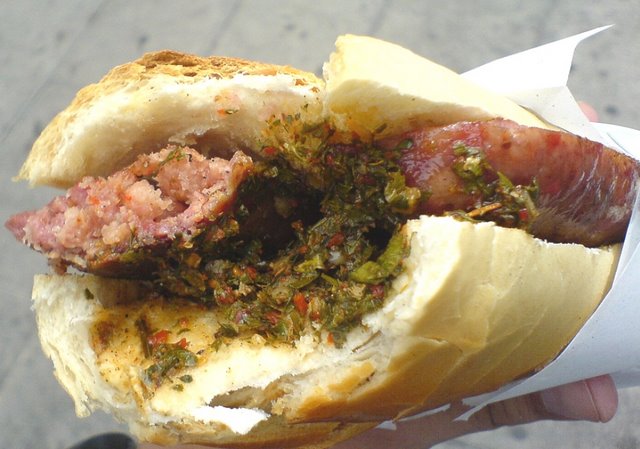
4.  After about an hour, put the chorizos on to cook.  When they are cooked through and juicy, make choripanes (chorizo + pan, "bread") for your guests by putting a chorizo in a roll (preferably a Chilean marrequeta), with a bit of pebre.  They still have an hour to wait for the main course, but and should be ready for a snack.


5.  When pink drops appear on the upper side of the lomo, turn the meat and continue to cook for another hour, after which pink drops will again appear on the top side.  It should be al punto, juicy and medium/medium rare.

6.  Rest the meat for 10 minutes, slice and serve with pebre (Chilean salsa) and salads.

If some of your guests prefer well done, common among Chileans, please do not cut off slices and return them to the grill.  They will quickly turn dog-biscuit brown and develop a dry, mealy texture.  Meanwhile the juices will run out of the un-rested remaining portion, forming an unappetizing pink puddle around the now dry roast. 

Instead, cut the raw loin into steaks, sear each side and grill to each person’s preferred doneness.  Or make antichchos, shish-kebobs, another Chilean favorite.  


  Antichchos


Other asados Chilenos

Asado al disco:  Not an 80s dance but a outdoor cooking technique that originally used a “disk” from a agricultural implement.  Sausages, vegetables, shellfish, cook in wine or just their own juices.  Disks with legs are widely available.


asado al disco


Asado Parado:  “Standing BBQ,” originally an Argentinean technique popular with lamb in the far south, suckling pig, and goat (as in the photo) in Argentina.  Goat (chivo) is also popular in Chile’s norte chico and norte grande.


Chivo asado parado


Links:

Instructions (in Spanish) for grilling a variety of Chilean cuts of beef or click here for a computer translation. The site also contains a useful chart of Chilean, Argentinean, US, etc., names for cuts of meat; pictures of the cuts and recommendations for wine pairings


Secrets of the Patagonian Barbecue, by Roberto Marín.  Excellent cookbook, including beef, pork, chicken, and fish on the grill, Chilean style. Also available in a bilingual edition.