Hiển thị các bài đăng có nhãn BBQ. Hiển thị tất cả bài đăng

Thứ Hai, 4 tháng 1, 2010

Eating Asado Chileno: Chilean Barbecue

Where don’t they celebrate summer with meat (or something) roasted over an open fire? Even vegetarians find a way to gather around the grill, smell the aromas and hear the sizzle. And Chile is, of course, no exception. The asado is the prime summer event, north and south, urban and rural. But of course, in a country 2,700 miles from north to south, there is a lot of variety. Here are two versions of the asado Chileno.


The rural asado al palo – Spit barbecued lamb in the country


My first experience with an asado Chileno was the real thing; traditional, rural, and with deep historic roots. I was in Chile’s lakes region, 500 miles south of Santiago, just outside the Huerquehue National Park. I was on my first trip to Chile spending a week in a small family hostal and eating the same meals as the family. One day my mid-day meal was a lamb cazuela: potatoes, squash, corn, rice and lamb innards (lung, liver, tongue, etc.) in an abundant garlicky broth. Not to everyone’s taste perhaps, but delicious and unusual enough that I asked about it.

“We killed a lamb and these are the parts that don’t go into the asado tomorrow.  All our uncles and cousins are coming, and of course, you are invited.”
As you see below, the lamb, impaled on two long sword-like skewers, was roasted over a wood fire.  Don Fundor Castro, the patriarch and asador controlled the cooking by moving the skewers from higher to lower supports as needed.

 Don Fundor tends the asado


When the lamb was done, the fat was crisp and succulent and the meat was well done, juicy in the thicker cuts. The women and children (and the gringo guest, holding the skewer in the photo) sat a long table holding a salad of fresh lettuce from the garden, boiled potatoes, home made bread, and wine, while the men of the family ate standing, cutting choice pieces for each other and for us with their belt knives. It was delicious and I felt honored to have been included.

 Since then I have attended many asados, and even cooked a few, but this was one of the best and certainly the most memorable—and quite unlike the typical suburban Santiago backyard asado.


The urban asado a la parrilla—Grilled beef in the city

While very different from the rural asado above, the urban asado shares many of its features and is, in turn, very different from the typical North American backyard barbecue of ‘burgers or steaks on the grill. Like the rural asaderos, Santiagueños prefer large cuts of meat--roasts rather than steaks--and they cook at lower temperature than US grillers, more like the slow cooked BBQ of the southern US.  They use natural charcoal and season only with salt—no marinades, rubs or sauces.  As in the US, and unlike rural Chile, beef is preferred, although pork ribs, sausages and chicken may share the parrilla.  Lamb is not appreciated, at least by the inhabitants of the barrios altos--socially and geographically Santiago’s “upper neighborhoods”.  

Also in contrast to the US, Chileans have much more tolerance for meat with character, flavorful meat than must be chewed.  Chilean beef is, with a few expensive exceptions, grass fed and comes largely from dairy or dual purpose dairy/beef breeds (see my discussion in “Eating Chilean Beef”).  Some of the favorite cuts are short ribs (asado de tira) and tip of bottom round (punta de ganso).  “Variety meats” (kidneys, sweet breads, intestines) are traditionally included, but find few fans among urbanites.

Steaks are also popular, but even here the differences in grilling styles are apparent.  Chilean chef Roberto Marín sears his 1-½ inch T-bone for 5 minutes on each side, then grills each side for 15 to 20 minutes over “medium heat” (250-350° F.) for a medium-rare to medium result.  The US web site “Cooking for Engineers” sears the same steak for 2 minutes on each side, then moves it to an area of “lower heat” to finish, saying: In general it should take about 7-8 minutes to cook to medium rare.” And he uses an instant-read thermometer. This is not the Chilean way.

Ready to try it Chilean style?  Here’s a recipe from Chilean chef Roberto Marín’s excellent Secrets of the Patagonian Barbecue:


Ingredients:
Beef loin, preferably a grass fed lomo vetado (rib eye), of around 8 lbs
Chorizos or other sausages
Salt, preferably coarse sea salt


Equipment:


parrilla, or grill, that can be raised or lowered (or with higher and lower shelves) and a poker or shovel to move the coals.


Fuel:

Natural charcoal, about 12 lbs.  Newspapers to start the fire

The Process:

1.  About 3 ½ hours before you plan to eat, start the fire by twisting newspaper into long tubes and wrapping around a bottle.  Pile charcoal around the paper and remove the bottle.  Drop a crumpled newspaper into the paper tower, and light.   The charcoal will light, but it will take time.  Be patient.  And start early.

Roberto Marín tell us:

Rural grillers and their guests are equipped with a saintly degree of patience that allows them to calmly endure long, leisurely hours while they wait for the hardwood to take light and slowly turn to white hot coals.  Urban grillers, on the other hand, are an impatient breed.  Forget about carefully building fires to transform wood into glowing embers.  They break with time honored tradition using gas grills or rushing the coals with blowers or hair dryers, or when technology fails, to huffing and puffing as they take turns blowing on the coals.


2.  When the coals are no longer flaming and are covered with a film of white ash, spread them evenly and adjust the grill height so that can hold you hand above the coals for about 1 to 2 seconds; high heat, 350 to 450° F.  Put the roast on the grill and sear the meat for about 5 minutes on each side.

3.  When the meat is seared, salt it liberally and raise the grill to a height where you can hold you hand for 3 to 4 seconds; medium heat, 250-350° F.  Put it fatty side down for about 1 hour and 15 minutes, adjusting the grill and adding charcoal as necessary to maintain the temperature.  (If you start a second batch of charcoal after about 20 minutes, you will be ready.)

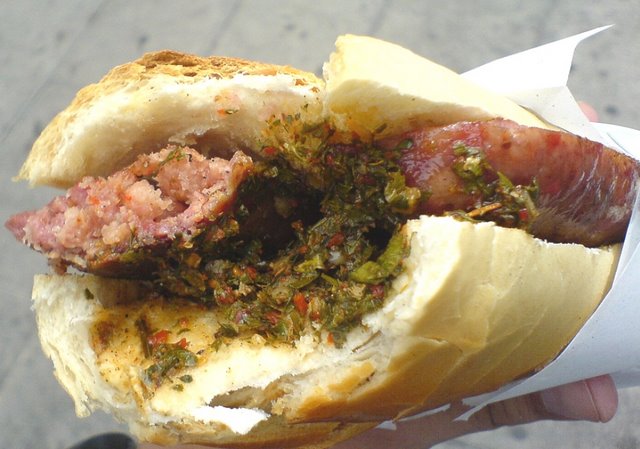
4.  After about an hour, put the chorizos on to cook.  When they are cooked through and juicy, make choripanes (chorizo + pan, "bread") for your guests by putting a chorizo in a roll (preferably a Chilean marrequeta), with a bit of pebre.  They still have an hour to wait for the main course, but and should be ready for a snack.


5.  When pink drops appear on the upper side of the lomo, turn the meat and continue to cook for another hour, after which pink drops will again appear on the top side.  It should be al punto, juicy and medium/medium rare.

6.  Rest the meat for 10 minutes, slice and serve with pebre (Chilean salsa) and salads.

If some of your guests prefer well done, common among Chileans, please do not cut off slices and return them to the grill.  They will quickly turn dog-biscuit brown and develop a dry, mealy texture.  Meanwhile the juices will run out of the un-rested remaining portion, forming an unappetizing pink puddle around the now dry roast. 

Instead, cut the raw loin into steaks, sear each side and grill to each person’s preferred doneness.  Or make antichchos, shish-kebobs, another Chilean favorite.  


  Antichchos


Other asados Chilenos

Asado al disco:  Not an 80s dance but a outdoor cooking technique that originally used a “disk” from a agricultural implement.  Sausages, vegetables, shellfish, cook in wine or just their own juices.  Disks with legs are widely available.


asado al disco


Asado Parado:  “Standing BBQ,” originally an Argentinean technique popular with lamb in the far south, suckling pig, and goat (as in the photo) in Argentina.  Goat (chivo) is also popular in Chile’s norte chico and norte grande.


Chivo asado parado


Links:

Instructions (in Spanish) for grilling a variety of Chilean cuts of beef or click here for a computer translation. The site also contains a useful chart of Chilean, Argentinean, US, etc., names for cuts of meat; pictures of the cuts and recommendations for wine pairings


Secrets of the Patagonian Barbecue, by Roberto Marín.  Excellent cookbook, including beef, pork, chicken, and fish on the grill, Chilean style. Also available in a bilingual edition.


Thứ Hai, 28 tháng 12, 2009

Eating Chilean Beef

Foreigners find Chilean cuts of beef confusing. They don’t look like the cuts they know and the names are even less helpful: lomo vetado (literally “vetoed loin”), lomo liso (smooth loin”), pollo ganso (“chicken goose”), huachalomo (“orphan loin?”), posta negra (“black post”), etc. 


Lomo vetado on the grill


And of course, there is a good historical reason.

Cattle were introduced into Chile in 1554 by Don Francisco de Alvarado, and as in California, Mexico and Argentina, they adapted to the local conditions and multiplied quickly.  By the 18th century they were so plentiful that:
...they were worth no more that 2 to 4 pesos and very often they were killed to take the tallow and the hide; the rest was thrown out as almost useless, or else they cut the defatted meat in thin strips, and sold the sun dried strips under the name charqui. This entirely indigenous method of conserving meat, characteristic of dry and burning climates, has since spread, developed greatly, and has become one of the most fruitful industries of the country.[1]


Road from Valparaiso to Santiago – Claudio Gay 1854[2]

This charqui (“jerky,” from the Quechuan for dry meat) became a staple of the Chilean diet.  (see Charquicán, tomaticán and other “—cáns”).  To make charqui the beef carcass is dissected into boneless pieces following the muscle structure. Expedition artist, Edmond Smith, Captain's clerk in the U.S. Navy on the U.S. Astronomical Expedition to the Southern Hemisphere, describes the process as he saw it in the 1850s.[3]


Each of the pieces was named and both the names and the tradition of boneless cuts continue in today’s Chile.   The chart below shows the major Chilean beef cuts.


By contrast, most American and European cuts of beef include bones, as shown below, and as a result there is simply no direct Chilean equivalent for many American and European cuts, and visa versa


Other differences between Chilean beef and American and European beef stem from the nature of the Chilean livestock industry.  Beef production in Chile is highly variable and much production is in the hands of small producers.  Average herd size is only 41 animals (compared to 200 in Argentina), and most of the beef comes from dairy breeds like Holsteins or from Holstein/Herford crosses  as many dairy operators “freshen” their milk cows by insemination with Herford semen to produce better beef animals. Additionally, beef is grass-fed rather than being fattened on corn in feed lots, as in the US.  This produces leaner beef, but since it is the “marbling” of fat within the muscle tissue that makes beef tender, it also means tougher beef. And finally, the grading system is based on the animal’s age, so that critics claim that identically graded carcasses (the top grade is “V” followed by “A”) may be of very different quality.[4]  

Never the less, beef continues to be Chileans’ favorite (and most expensive) meat, though it is now third in consumption at 22.1 Kg (48.6 lbs.) per year behind pork and chicken and is declining.[5]


Of course there is better (or at least more tender) Chilean beef available.  Certified Angus beef and other quality feed-lot beef is available for about twice the price of standard beef (presently loin cuts are selling for around $10 US/lb) and there is also “Premium Quality Kobe Style Wagyu Beef, Naturally Raised in Chile”  for around $60 a kilo for the best cuts; cuts said to sell for $300 a kilo in Japan and $200 in the US.[6]

Beef from Argentina, Uruguay, Paraguay and the US is also commonly available in supermarkets at about the same prices as Chilean beef, but whether this is better beef is a matter of opinion.[7]  Chileans surveyed in 2004 preferred Chilean beef over imported beef, even when the imported beef sold for 15% less, and only 7% of the sample considered imported beef better; an admirable (if misplaced) example of culinary patriotism.[8]

So, how do you know what Chilean cuts of beef to buy? 

For BBQ, Chilean asado, as roasts:  lomo vetado (rib eye) or lomo liso (short loin/sirloin) are good choices.  Lomo vetado is fatter and produces a juicer roast (essential for those poor souls who prefer well done); lomo liso is leaner and is apt to be dry if cooked beyond medium-medium rare.  Sobrecostilla and asado carnicero from the shoulder or chuck are also good on the grill, full of flavor, though tougher, as is asado de tira, short ribs.  All are best cooked no more than medium.


For grilling, American Style, as steaks:  lomo vetado (rib eye), lomo liso (short loin & sirloin) and filete (tenderloin), cut into steaks.  Entrtecot (T-bone steak) is common on restaurant menus, and is occasionally available in supermarkets. Entraña (“skirt  steak”) is a tender thin cut that can be grilled quickly.


Filete

For braising and stews: The Chilean favorite is plateada (“rib cap”), but any of the shoulder cuts (huachalomo, choclillo, malaya, posta paleta, asado Americano [Imported US chuck roast] etc.) or the leaner and dryer round/rump cuts (posta negra, posta rosado, asiento picana, ganso, pollo ganso [eye of round], etc.) are suitable.  Expect to simmer 2 to 2 ½ hours.  Brisket is tapapecho.

For soups, cazuela, etc.:  Cuts with bone like osobuco (shin), asado de tira (short ribs), or any of the cuts for braising, above.


Links:
TÉCNICAS DEL BUEN ASADOR provides Chilean names for cuts of beef, along with photos of the cuts and cooking recommendations, in Spanish.  For a computer translation, with some imaginative literal translations, see English version.
Beef Cuts is a chart put out by the Argentine government which gives names of beef cuts in Argentina, Spain, Brazil, Chile, Portugal, USA/UK, France, Germany/ Switzerland, and Italy.

          Whole Foods Market Chilean Grass Fed Beef Program - It's not exactly the same beef you get at your local Chilean supermarket, but it's an interesting development.


[1] Gay, Claudia 1862 Agricultura Vol 1, p. 20. Chile: Museo de Historia Natural de Santiago. Online at http://www.memoriachilena.cl//temas/documento_detalle.asp?id=MC0002687 
[2] Gay, Claudio. 1854.  Atlas de la historia física y política de Chile / por Claudio Gay. París : En la Impr. de E. Thunot,  On line at  http://www.memoriachilena.cl/temas/documento_detalle2.asp?id=MC0001981
[3] Smith, Edmond Reuel   The Araucanians or, Notes of a tour among the Indian tribes of southern Chili.  New York, Harper. P. 100 on line at http://www.archive.org/details/araucaniansnote00smitrich
[4] Azzopardi, Tom.  2004 Putting meat on the FTA’s bones. bUSesschile November 2004 - Nº219. On line at http://www.businesschile.cl/imprimir.php?w=old&lan=en&id=40;  Dresdner, J. 2004. La industria bovina en Chile: enfrentando las desventajas comparativas.   Ciencia e investigación agraria: revista latinoamericana de ciencias de la agriculturaVol. 31, Nº. 1, 2004 , p. 51-65.  On line at http://www.rcia.puc.cl/Espanol/pdf/31-1/ensayo.pdf; Long, Bob. 1996.  Beef logic: The beef industry in Chile. Angus Journal Sept. 1996.  On line at http://www.angusjournal.com/ArticlePDF/0996_BeefLogic.pdf
[5]Anonymous. 2009. Chilean production of wine and meat increases.  Communications Office National Statistics Institute, September 15, 2009 On like at http://www.ine.cl/canales/sala_prensa/noticias/2009/septiembre/not150909_eng.php?lang=eng
[6] Harison, Sophie. n.d.  Breeding Wagyu Cattle in Chile. bUSiness Chile. On line at

[7] Lasmallen. 2008. Carne Nacional??... Sííí, Por Favor!!!  La Buena Vida. On line at http://www.labuenavida.cl/content/view/226288/Carne-Nacional-Siii-por-favor.html
[8] Schnettler, B., O. Manquilef & H. Miranda. 2004. Atributos valorados en la selección de carne bovina por el consumidor de supermercados de Temuco, IX región de Chile. Ciencia E Investigacion Agraria, Vol 31 No 2 Mayo - Agosto 2004. p.91-100. On line at http://dialnet.unirioja.es/servlet/articulo?codigo=2174054

Thứ Hai, 21 tháng 9, 2009

The Eighteenth: Chilean Independence Day

In Chile “the eighteenth” (September 18), has the meaning that “the fourth” once did in the US: patriotism; nationalism; Chilean unity; military might, the end of winter; and of course, Chilean food and drink. Celebration begins at noon the day before, is stretched over a week, and is lubricated by a bonus given to Chilean workers.
.
Celebrants in the Parque Intercomunal Padre Hurtado


Throughout Chile, parks are turned into fair-grounds with booths selling all that is typically Chilean:  here  hats, ponchos and boots of the Chilean cowboy, the mythic huaso (pronounced “waso”).


And there are rodeos with real huasos (or at least real huasos urbanos) and demonstrations of horsemanship by the military and the national police…


…and games for children.


But the real stars of El Dieciocho are empanadas and chichaEmpanadas, meat, seafood or cheese-filled pies, are the height of “Chilenidad” and the original Chilean fast food.  They are inexpensive, good, filling and can be eaten out of hand.


 And chicha[1], partially fermented grape juice, is the ideal companion for empanadas.  Fresh, tart and slightly sweet, the best is artisanal, un-filtered, un-pasteurized, and produced from the fall harvest.  Its alcohol level depends on the sugar content of the grapes and the length of fermentation, but it usually seems to be 3 – 5%.


 But once the obligatory empanada and chicha are dealt with, the serious eating and drinking can begin.  By far the most popular foods for the 18th come from the parrilla, the grill.  High on the list are anticuchos[2], mixed meats and sausages skewered with onions and grilled, and served with a marraqueta – a Chilean French-roll.


And there are chorizos (sausages) served on a split marraqueta, hotdog-style to make a choripan…


 And ribs.


And in the bowls at right, pastel de choclo, literallycorn pie,” with a filling of beef and onions, plus a piece of chicken, hard-boiled egg and an olive.


Plus pigs and lambs, roasted Patagonian style.


And to drink, more chicha, beer, wine, pisco (Chilean brandy), and pipeño (a light sweet wine), plus those Chilean classics, Pepsi and Coke.


Celebration is communal.

And if you still crave something sweet, candy from nearby Mendoza, Argentina.

  
It’s a lot like an old fashioned US celebration of the fourth, but without corn dogs.  


[1] In South America chicha is a generic term for drinks made of fruit or corn, usually fermented with low levels of alcohol.  In Chile chicha is usually made of grapes, or in the south, apples.  “Cider” is a close English equivalent.
[2] “Anticucho” is from the Quechua for “cut meat stew” see http://en.wikipedia.org/wiki/Anticuchos