Thứ Hai, 19 tháng 10, 2009

Mote con Huesillos, Chile’s favorite summer sweet

On my first trip to Chile, in 2005, I kept seeing stands selling “mote con huesillos.”  My Spanish-English dictionary was no help, so I tried it and found it to be a stewed dried peach served in a glass with lots of light syrup and a few tablespoons of soft cooked wheat—a bit odd, but tasty and refreshing; thought I couldn’t quite understand its popularity. 

But popular it is, and according to Chilean folklorist Oreste Plath, “In summer mote con huesillos is the refreshing drink and dessert with Chilenedad:  for good reason they say “More Chilean that mote con huesillo.”[1]


History

“What is mote?” asks the European.  Nothing more or less than wheat boiled with lye, which by its strength and the heat of the fire causes the grain to loose its husk, and then washed several times in water to rid it of the lie taste, although it is never completely removed. (Recaredo Tornero, Chile ilustrado 1872)[2] 

The word mote is from the Quechan mut’i meaning cooked grain[3] —usually maize (“corn” in American English), although in Chile it refers to wheat, cooked, as Tornero explains, in an alkaline solution of lye or wood ashes.  Corn mote is motemei (mote de maíz) in Chile.

This Amerindian alkiline cooking process, called “nixtamalization” after nixtamal, the Mexican equivalent of mote, seems to have originated in Guatemala sometime around, 1200-1500 BC.  It softens dry maize kernels and removes the bran (or pericarp), making grinding easier and tortillas less fibrous. But more important, it makes maize more nutritious.  A classic article published in Science in 1974 explained that maize protein is unbalanced in its amino acid composition and is low in available niacin, vitamin B3.  Cooking the kernels in alkaline water improves this balance and makes the niacin more available.   “…without alkali processing of corn, there would be a considerable degree of malnutrition in societies where corn is the major part of the diet.” [4] And, in fact, societies in African and India, as well as in the American South, that depended on corn as their staple food, but did not use alkali processing, suffered form pellagra—a disease caused by niacin deficiency.  Pellagra is rare to non-existent in Mesoamerica, where lime processing is near universal, and there is a strong correlation between the importance of maize in the diet of American Indian cultures and their use of nixtamalization.  The more maize in the diet, the more likely that it is made into nixtamal and visa versa.

From Guatemala, nixtamalization spread north and south throughout the maize growing areas of aboriginal North and Central America—but, as far as we know, no further south than Columbia.[5]  Although maize was grown throughout South America, it was not the staple it was in Mexico; potatoes and quinoa were important in the Andes and manioc was a staple in Amazonia.

In the south-eastern United States the finished product of corn cooked in lye water is “hominy,” probably from the Virginia Algonquian uskatahomen.   When dried and coarsely ground, it becomes the southern favorite, hominy grits.  Unfortunately for southerners, hominy and grits were not the staples: unprocessed corn meal was, and “in the early 1900s, pellagra reached epidemic proportions in the American South. There were 1,306 reported pellagra deaths in South Carolina during the first ten months of 1915; 100,000 Southerners were affected in 1916.”[6]


In Mexico and Central America nixtamal (from the Aztec language, Nahuatl), is ground and made into tortillas or tamales, the staple Mesoamerican foods for thousands of years.  Years ago, I described the process among Isthmus Nahuat  Indians in Vera Cruz, Mexico:

The woman of the household knows approximately how many ­manos­ - units of five ears each - of maize her family consumes each day and shells enough maize for two or three days.  While the maize is being shelled, a bucket full of water is brought to a boil over the fire and a handful of lime (nesti) is added.  When the water comes to rolling boil the maize is poured in and cooked for about l0 minutes, then is taken from the fire and allowed to soak until needed.  After cooking, the maize kernels, now called ­nixtamal, are taken to the near by stream for washing.  There the maize is rubbed between the hands until the tough outer skins loosen and come off. The maize is rinsed repeatedly until the skins all are washed away and the rinse water is clear, then it is returned to the house for grinding.[7]

A remarkably similar process is followed by Sra. Luisa Quidel, a Mapuche woman who grows wheat from which she makes mote de trigo (wheat mote) for sale in the streets of Temuco, a Chilean city in the heart of Mapuche country.  Eugenia Aguilera Vega describes the process:

After the wheat is harvested you must obtain ashes for processing the wheat from a local bakery.  The ashes need to be cleaned and passed through a sieve to make good wheat mote.  The mote must be cooked at a suitable temperature for the best results, so it is done over a wood fire.  It is a slow process, but gas is too expensive.  Next the water is drained off, and the mote, husks now loosened by the ashes, is peeled.  It is scrubbed by hand and this is also a sacrifice; it is tiring work and there is no one to help her. The process is finished when the mote is well washed and allowed to rest until she leaves to sell it early the next morning.[8]
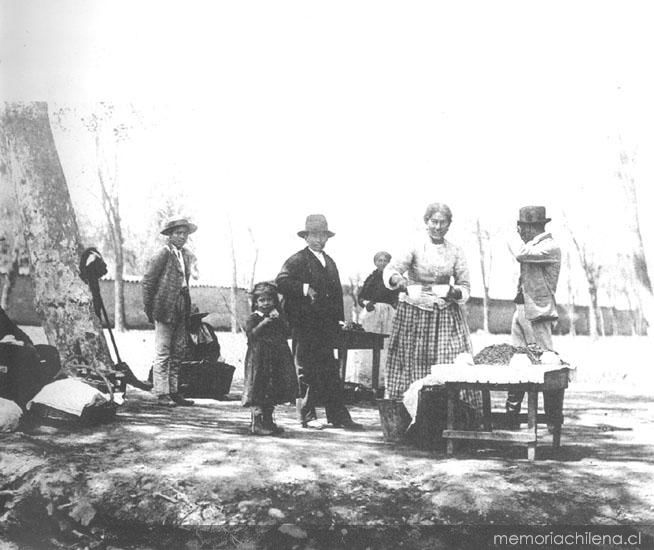
 La Motera, the Mote vendor

But how did the Mesoamerican process of nixtamalization come to Chile, and how did it come to be applied to wheat?   

Although I fond no evidence to explain its arrival, the Spanish probably brought nixtamalization to Chile.  It was almost universal in Mexico, and a lively trade existed between Peru and Mexico during the century after the conquest.[9]  Nixtamalization is also part of the colonial cuisines, but not the indigenous cuisines, of Peru, Bolivia, Argentina and Venezuela.[10]

Mapuche servants tended the fires and kitchens in colonial Chile, and the process evidently diffused into Mapuche culture—where it was called kako--not only for maize, but for wheat[11] and legumes.[12]


Wheat mote became a regular part of Chilean Creole cuisine for colonists as well as for the Mapuche.  It could be eaten fresh, after processing, or could be dried for later use.  Dried mote is prepared by boiling in abundant water for a half hour of so.

Traditionally it was eaten like rice or mixed with a little of its cooking water, or in pottages.  La Gran Cocina Chilena, the classic Chilean cookbook, offers recipes for mote with: peas, cream, milk, potatoes, and country style (with winter squash and sugar) as well as mote con huesillos.  Most are creamy risotto-like dishes:  sturdy, filling and a bit bland.  

But contemporary Chilean chefs are beginning to use mote in other ways:

Potatoes with mote, curry and herbs, Haydee Manzo


Pebre de MoteBB CuisineSantiago


 I first used mote as an addition to whole wheat bread, but now make mote pilaf (right), and the middle eastern salad tabule, substituting mote for bulgur.  Actually, mote can be substituted for other grains (wheat berries, brown rice, bulgur, pearled barley, etc.) in most recipes. 


But back to mote con huesillos: 

Given its popularity, I assumed that mote con huesillos was one of those dishes, like North American dried apple pie, that satisfied the sweet tooth of rural households in winter when cupboards were bare of fresh food.  Both are products of subsistence farming, storable for long periods, and likely to be available to people of very modest means.  But I was wrong. 

The two products seem to have come together in urban Santiago of the late 19th Century.  By the 1870s, Recaredo S.Tornero’s Chile Ilustrado shows that mote had begun to be associated with huesillos
The cry of the motero [mote vendor] announces the coming of summer, the epoch when his sales begin.  What does the motero do during the winter?  No one knows; but it is in the hot season that one hears him in the streets calling “Huesillos”  and ”Fresh mote,” for no one would sell mote alone.  … The measure the motero uses is a large china cup at the reasonable price of one cuartillo (3 cents), including the same cup full of water which he always has in a clay pitcher.
And what about the huesillos?  They are just cooked dried peaches, to which they usually add toasted flour.[13]  
 But were they served together, as in today’s dish?  Chilean blogger Criss Salazar thinks not, noting in his excellent blog Urbarorium on Santiago history, that the mote was sold with its cooking water and the huesillos were eaten with toasted flour.  (See El Mote con Huesillos: Historia de una Mezcla Ganadora[14]).

So when did the combination begin?  Probably a little later.  But by the beginning of the 20th century it had become popular in Santiago[15] and today “nothing is more Chilean than mote con huesillos.


A recipe for mote con huesillos?  Of course.  My Chilean wife, whose mote and huesillos are pictured above,  does it like this:


-------------------------
[1] Plath, Oreste.  1962. Geografía gastronómica de Chile.  En viaje / Empresa de los Ferrocarriles del Estado. Santiago : La Empresa, 1933-1973. v., año XXIX, n° 343, (May 1962), p. 181–184 On line at http://www.memoriachilena.cl//temas/documento_detalle.asp?id=MC0023119 (all translations mine)
[2] Tornero, Recaredo.  1872 Chile ilustrado: Guía descriptivo del territorio de Chile.  Valpariso:  Librerias I Ajencias del Mercurio. p. 468. On line at http://www.memoriachilena.cl/temas/documento_detalle.asp?id=MC0012105
[3] Coe, Sophie D. 1994.  America's First Cuisines.  Austin:  Univeristy of Texas Press p. 223; Mote, Wikipedia en Español on line at http://es.wikipedia.org/wiki/Mote
[4] Katz, S.H., M.L. Hediger and L.A. Valleroy. 1974. Traditional maize processing in the New World. Science 184: 765-73.
[5] Katz, et al. 1974; Coe, 1994.
[7]  Stuart, James W. 1978. Subsistence ecology of the Isthmus Nahuat Indians of southern Veracruz, Mexico. University of California, Riverside.
[8] Aguilera Vega,  Eugenia. 2007. Mote: Gusto para unos, vida para otros.  Centro de Medios Independientes Santiago, on line at http://santiago.indymedia.org/news/2007/06/70390.php
[9] Borah, Woodrow Wilson. 1954.  Early colonial trade and navigation between Mexico and Peru. Ibero-Americana ; v. 38.  Berkeley, University of California Press.
[10] Mote, Wikipedia en Español on line at http://es.wikipedia.org/wiki/Mote
[11] It would be interesting to know what nixtamalzation does to the nurtitaional value of wheat, but I found nothing on the subject.
[12] Jelves Mella, Ivonne, et. al.  n.d. Manual Para La Promocion De Alimentacion Tradicional Mapuche.  Asociacion Para La Salud Makewe Pelale. Hospital Makewe.
[13] Toreno, 1872 p. 468
[14] Salazar, Criss .El Mote con Huesillos: Historia de una Mezcla Ganadora. Urbatorium on line at http://urbatorium.blogspot.com/2009/01/el-mote-con-huesillos-historia-de-una.html
[15] Palma Alvarado, Daniel. 2004. De apetitos y de cañas. El consumo de alimentos y bebidas en Santiago a fines del siglo XIX. Historia, 37 (diciembre)  p. 395 on line at  http://redalyc.uaemex.mx/redalyc/src/inicio/ArtPdfRed.jsp?iCve=33437205&iCveNum=1317#


Thứ Bảy, 3 tháng 10, 2009

Eating Chilean wild mushrooms (hongos silvestres Chilenos)

 Last year about this time, I saw a man in La Vega, Santiago’s central market, selling these odd little golf-ball like things from a large basket.

 “What are they?” 

Dihueñes, wild mushrooms, 6,000 pesos per kilo.” (about $5 a lb.)

“What do you do with them?”

“Make a salad with cilantro and onions, muy rico.”

“Give me a quarter kilo.”

Having managed to forget the name by the time I got home, I spent a few hours on the internet looking for what I had found.  They were Dihueñes (Cyttaria spp.), that fruit in the spring and are collected September through November when it is “common to find them in local markets or from street vendors in the Central-Southern zone of the country.”[1]

And, as it turns out, I was not the first gringo to find them interesting.  Charles Darwin, traveling in Tierra del Fuego in June, 1834 wrote:

There is deserving notice from its importance as an article of food to the Fuegians. It is a globular, bright-yellow fungus, which grows in vast numbers on the beech-trees. When young it is elastic and turgid, with a smooth surface; but when mature, it shrinks, becomes tougher, and has its entire surface deeply pitted or honeycombed, as represented in Plate 55.
 This fungus belongs to a new and curious genus (…Cyttaria Darwinii: the Chilean species is the C. Berteroii.) …How singular is this relationship between parasitical fungi and the trees on which they grow, in distant parts of the world! In Tierra del Fuego the fungus in its tough and mature state is collected in large quantities by the women and children, and is eaten un-cooked. It has a mucilaginous, slightly sweet taste, with a faint smell like that of a mushroom. With the exception of a few berries, chiefly of a dwarf arbutus, the natives eat no vegetable food besides this fungus.[2]

I followed the vendor’s advise (and a recipe I found) and made a salad with onion, cilantro and vinaigrette.  As Darwin noted, they are a little slippery, with a flavor that might be described as subtle:  go lightly with the onion and vinaigrette or that is all you will taste. 
 .

The Mapuche of south-central Chile suggest that you try Dihueñes  in empanadas, as in this recipe below from Cocina Mapuche.[3]
 . 

In the process of reading about my Dihueñes, I discovered Carlos D. Cisterna Lagos excellent article “Explotación de Hongos Silvestres en Chile[4] (“Exploitation of Wild Mushrooms in Chile”) from which I have summarized most of what follows.  Several of the photos are also from Hongos de Chile. 

My first surprise was that:

Chile has become one of the major world exporters of wild mushroom, exceeded only by China, Russia and Poland.  With returns of over 50 million US dollars a year, it is without doubt, the most important activity related to non-lumber forest products. As many as 40 thousand people between Valparaiso and Magallanes participate directly in mushroom collecting or processing for more than 35 exporting enterprises.  Some communities are completely dedicated to this activity during fall and winter, for example Empedrado (Region VII), considered the capital of wild mushroom collecting in South America.

The major species are:

The dark pine mushroom, callampa del pino oscura [5](Suillus luteus), and..


the light pine mushroom, callampa del pino clara (Boletus granulatus).

These two mushrooms of northern hemisphere origin are found in plantations of Monterrey Pine in south- central Chile, and were presumably introduced accidently with the trees.  The dark pine mushroom, the most collected Chilean mushroom, produces up to 3 tons per hectare from late fall through early spring.  The light pine produces less and is somewhat earlier.  The two are usually collected and dried together and sold mixed as Callampas. They are widely available in Chile, where supermarkets sell 35 gm (1¼ oz) packages for around 750 pesos ($1.40) and the tostaduria sells 100 gm. for under 1000 pesos $1.85) [6]   Callampas comprise about 90% of Chile’s mushroom exports.[7] 


They can be used in the same was as porcinis or other dried mushrooms:  rehydrated and added to pasta sauce, stews, soups, etc., or see these dried mushroom recipes.  To really appreciate their flavor, try the risotto.  


Red Pine Mushroom - Callampa Rosada (Lactarius deliciosus)

This is another introduced mushroom of northern hemisphere origin, and as its scientific name indicates, one of the most desirable. It is found in spring—or as late as June in the far south—in pine plantations.  It is sold fresh or in brine:  If you find any fresh ones in Santiago, please let me know. 


Black morel, Colmenilla (Morchella conica)

Occasionally while living in Illinois, morel mushrooms would come up in my back yard along a roadway embankment.  They weren’t Morchella conica, but probably were yellow morels.  One way or another they were wonderful and I look forward to finding fresh morels in a Chilean mercado someday.  They are a spring mushroom, found in both pine plantations and native forest, usually in disturbed or burned areas.  They are exported dried, but may occasionally be found in markets in south central Chile—and maybe someday in La Vega.  I’ll be looking.  (And, FYI, morel recipes abound on the web.)


Chicharrón (Gyromitra antarctica)
  
This South American mushroom has no common English name, but a close North American relative is the “false morel.” They occasionally kill people. The Chilean species is said to be of “low toxicity,” and to loose its poisons when well cooked or dried. Dried, it is exported to Europe.  I won’t be trying this one fresh.


Coral fungi, Changle (Ramaria flava)


A fall and winter mushroom of native forests in the Lakes Region of Chile.  They are not exported, but street and market vendors are said to be common in season in Temuco, Pucón, Chillán, Concepción, Temuco and Valdivia.  


They are eaten in empanadas and in other fresh mushroom preparations. People from the region are enthusiastic about them, based on comments a fellow blogger received about them:

I’m from Coronel and, for your information; there is a señora here who serves a plate of changles for only 500 pesos.  It’s one of the most delicious things you can eat, and I doubt that a chef could give a recipe more attention. Janny

I’ve tried to try as many of the diverse products of this area as possible and one of my favorites is changle simmered with onion, minced chives, a dollop of thick cream and a touch of white wine. ¡Buen provecho !  Yudi

Gargal (Griffola gargal)


A spring mushroom of the pine plantations, the gargal is considered one of the best of Chile’s wild mushrooms.  It is usually sold fresh or in brine. A similar species of the same genus is native to the US where it is called “hen of the woods.”


Loyo (Boletus loyo)
This is a Chilean and Argentinean mushroom of a world-wide genus that includes the Italian porcini.  In Chile it is a late summer and fall mushroom of the native southern forests.  It can grow large, up to three pounds or so and “…due to its delicious, nut-like taste it is traditionally collected and consumed by native Chileans and can be occasionally purchased on local markets during the season.”[8]  I’m looking for this one too.


See reference [9]


[1] Cisterna Lagos, Carlos D.  2006-07 Explotación de Hongos Silvestres en Chile. (c) Carlos D. Cisterna Lagos, 2006 -2007 On line at http://www.micotec.cl/silvestres1.html
[2] Darwin, Charles.  Voyage of the Beagle, Chapter IX.  The Complete Works of Charles Darwin, on line at http://www.darwin-literature.com/The_Voyage_Of_The_Beagle/12.html  The illustration is from http://darwin-online.org.uk/content/frameset?viewtype=text&itemID=F10.3&pageseq=1
[3] Portal de as culturas originarias de chile Ser Indígena, Gastronomía, Cocina Mapuche on line at http://www.serindigena.cl/index/gastronomia/gastro_mapuche_2.htm. For information on preparing empanadas in the “traditional way” see http://southamericanfood.about.com/od/snacksstreetfood/r/empanadaschile.htm
[4] Cisterna Lagos, op cit.
[5]Callampa” = mushroom from Quechuan.  The term is also used in Chile for settlements of poor people that “spring up like mushrooms” on the outskirts of citgies. See http://etimologias.dechile.net/?callampa
[6] For comparison, in the US a 1 ¼ oz packet of Chilean dried mushroom costs about $3.50, domestic dried mushrooms cost around $5 and European porcinis, around $9.
[7] Mercado y Comercialización de Productos Forestales No Madreros en Chile, 4.3 Caracterización comercial de los Hongos, on line at http://www.gestionforestal.cl:81/pfnm/mercado/txt/hongos.htm
[8]Palfner, Götz. Boletus loyo.  Macrofungi from Chile on line at http://www.chilefungi.cl/album/bol_loyo.htm
[9]Plant and mushroom intoxications are an uncommon event, but can seriously compromise those that ingest them. Despite its low incidence, public and medical community education is essential to prevent and manage these intoxications efficiently.”  Manríquez O, Varas J, Ríos JC, Concha F, Paris E. 2002.Analysis of 156 cases of plant intoxication received in the Toxicologic Information Center at Catholic University of Chile. Abstract on line at http://www.ncbi.nlm.nih.gov/sites/entrez

Thứ Hai, 28 tháng 9, 2009

Pomaire Pottery/Greda de Pomaire

One of the most important characteristics of Chilean Creole cuisine is its cooking vessels; clay pots from Pomaire. They come in a variety of sizes and shapes, from the classic olla (pot), to casseroles, pitchers, water jars, plates and bowls; they hold heat wonderfully, are said to impart a special flavor to food, are inexpensive, and can be used in the oven or directly over a flame.  A pastel de choclo (corn pie) or paila marina (seafood stew--paila is the earthenware bowl) is almost unimaginable in anything else.[1]


Pomaire olla, a Motera grande


Paila marina


Click map to enlarge

Pomaire is a village of 10,000 or so, some 35 miles SE of Santiago. The village owes its name to Curaca Pomaire, leader of a group of Indians who in 1482 were settled to the north of today’s Pomaire.  In 1583 they were evidently expelled from property of their encomendero,Tomás Pastene, and settled near present day Pomaire as a Pueblo de Indios, and Indian Town.  Such indigenous communities, common in Mexico and Peru but relatively rare in Chile where most rural Indians and mestizos were attached to a hacienda as laborers[2], were used by the conquistadores and their descendants to house Indians displaced from lands the colonists wanted for their own uses.  Evidently this was the case with Pomaire’s Indians.  The village was established in its present location in 1771, and pottery making on a commercial scale evidently started shortly thereafter. [3]

The pottery technology used in Pomaire seems to have been that of the indigenous Mapuche.  Visiting the nearby village of Melipilla in 1822, Englishwoman Maria Graham found that the technology there was the same as she had observed earlier near Valparaiso.  There was…
…no regular manufactory, no division of labour, no machinery, not even the potter's wheel, none of the aids to industry which I had conceived almost indispensable to a trade so artificial as that of making earthenware. At the door of one of the poorest huts, formed merely of branches and covered with long grass, having a hide for a door, sat a family of manufacturers. They were seated on sheep-skins spread under the shade of a little penthouse formed of green boughs, at their work. A mass' of clay ready tempered lay before them, and each person according to age and ability was forming jars, plates, or dishes. The work-people were all women, and I believe that no man condescends to employ himself in this way, that is, in making the small ware: the large wine jars, &c. of Melipilla are made by men.[4]


While I found no description of the process in Pomaire, Mapuche chief Pascual Coña dictated a description in Life and Customs of the Indigenous Araucanians in the Second part of the XIX Century. 

Some of the old-time women were very skilled in the art of pottery; making various pitchers, jars, pots, plates, cups: all kinds of clay vessels….  When the clay was well mixed a handful was taken to work with.  First a round vessel bottom was formed from the clay.  Then another handful was molded into a strip or “piulo” using the palms of both hands.   When this piulo was long enough it was placed on the round bottom following its circumference, and was pressed into the base with the fingers.  Then a second handful of material was pressed onto the previous strip and the grove between the two piulos was smoothed inside and out.  The later work proceeded in exactly the same way.  According to what they wanted to make, the width, height and form of the vessel were formed.  As they were very experienced in their art, they produced many different shapes.[5]

While the technology seems to have been indigenous, the shapes were largely determined by Spanish taste.  The pieces below, and the one following the first paragraph, above, were made by Teresa Muñoz:

…born in Pomaire in 1915, learned the craft from her grandmother and mother.  She has practiced it since she was 16.  She works in the old style, forming the shapes by hand and repeating the patterns made by her ancestors.  She obtains the clay, already prepared, from the same area. She is one of the few artisans who maintain the tradition in the way she works and in the patterns she follows. [6]
  Paila (bowl)

More of her pieces can be found on line: see Traditional ceramic pieces from Pomaire, Collection of traditional Chilean craftwork, Pontifical Catholic University of Chile.


Today Pomaire is an attractive tourist destination for Santiagueños and visitors, who come on weekends and holidays to window-shop, buy pottery and other handicrafts, and to enjoy the Chilean Creole cuisine.


Dozens of shops line the main street.  Some include artisans demonstrating their work.  Today’s technology includes the wheel, but it remains an artisanal craft.


Prices are reasonable.  The casseroles to the right were 3,500 CLP, about $6.50 US.


  In addition to utilitarinan ware there are figurines, such as these crèche figures.


And other, non-religious novelties.


And there is food to take home or eat on the street.


And restaurants serving traditional Chilean Creole cuisine in pleasant shady patios.


But back to the pottery:  it is unglazed earthenware, thick and relative good at even heat distribution.  It can be used in the oven, over a flame or on charcoal, for roasting, sautéing, boiling or simmering, and for serving.  It keeps food warm for a long time.


Many people recommend that you “cure” new pieces; although it is not essential (my wife used her greda for years without curing any). The idea behind curing is to seal the pores of the clay.   Many techniques are recommended, but for pots that will be used for soups, stews, cooking beans, etc., boiling whole milk (preferably fresh from the cow) for 10 minutes or so seems the most common.  Others recommend boiling water with a good dollop of oil or lard added. (I tried this with my new piece, above—seems to have done no harm.) For casseroles, platters, bowls, etc., oiling the surface and then heating for 5 to 10 minutes in a hot oven is recommended.[7]

A few other suggestions:
  • For long simmered sauces, etc., that may burn on the bottom, use a heat diffuser 
  • Pre-heat casseroles that will be used in the oven for lasagna, baked chicken, etc. or expect to add 10 minutes or so to the cooking time.
  • Preheat bowls for serving soups and stews, cazuela, paila marina, etc.
  • Cook individual pastel de choclo, shepherd’s pie, mac & cheese, pot pie, etc. in greda bowls.
  • Use some caution in adding cold liquids to a hot casserole or immersing one in cold water. Greda is durable, but it’s not cast iron.
  • Don’t be overly cautious.  Sauté onions and garlic in the casserole, brown some meat, add wine, vegetables, simmer or pop in the oven. Take to the table and serve out of the pot with crusty bread and more wine. Enjoy. 
 Casuela de ave from a Pomaire restaurant


[1] Some take-out places sell pastel de choclo in bowls of greda for an extra $1 or so.
[2] Bauer, Arnold J. 1975.  Chilean Rural Society from the Spanish Conquest to 1930.  Cambridge Latin American Series, 21.  Cambridge University Press.  P. 47
[3]  Popular accounts of the early history of Pomaire such as the one published by El Detallista (Pomaire crèche y se proyecta a futuro, on line at http://www.eldetallista.cl/edi71/Vitrina/pomaire.htm) seem to be sanitized, ignoring the circumstances under which Indians were dominated and exploited by the Spanish.  Discussion of the founding of the Pueblo de Indios of Pomaire come from Los Indígenas De Chile Central, Informe Comision Verdad Historica Y Nuevo Trato - 2001- 2003, Vol 1, Part 1, Chapter 2, p 74 on line at http://www.serindigena.org/territorios/recursos/biblioteca/monografias/historia/documentos/2_primera_parte_I_historia_antigua_cap2.htm .
[4] Graham, Maria. 1824. Journal of a Residence in Chile, During the Year 1822.  London: Longman, Hurst, etc. On line at http://www.archive.org/search.php?query=Journal%20of%20a%20residence%20in%20Chile%20AND%20mediatype:texts
[5] Wilhelm de Moesbach, P. Ernesto. 1930 Vida y costumbres de los indígenas araucanos de las segunda mitad del siglo XIX.  Santiago: Imprenta Cervantes P. 216.  My translation of the Spanish translation.  On line at  http://www.memoriachilena.cl/archivos2/pdfs/MC0008879.pdf
[6] 2001 Piezas de alfarería tradicional de Pomaire, ARQ (Santiago)  n.49 Santiago dic. 2001 on line at http://www.scielo.cl/scielo.php?pid=S0717-69962001004900021&script=sci_arttext.
[7] Facebook discussion board, Artesania a domicilio, Cuidados de los pocillos de Greda, on line at http://www.facebook.com/topic.php?uid=95777677776&topic=8172